Showing posts with label religion. Show all posts

Monday, 4 April 2011

The "Special Status" of Christianity


I've been reading the blog of Jack Hudson for a while now. He's without doubt one of the most interesting and thought-provoking advocates of Christianity with whom I've had the pleasure to exchange views. While he doesn't always have time to answer my questions, the discussions are interesting and extensive enough that I don't have to feel like it's filler if they get too long and post them on my blog (as opposed to his comments section).

Jack has recently engaged Mike Doolittle in the comments section to one of his latest blog-posts. I'd like you to extend on a couple of the points you made, Jack. I'm copying and pasting them here, with my own questions below them. Mind you, I'm not posting them here in an attempt to disprove or contest what you're saying. To the contrary, I'd like to see you elucidate your views. Unfortunately while I appreciate your civility and intelligence, I often find your arguments to be too broad and sweeping to give me a clear sense of what you're saying. So I still haven't made my mind up whether they denote a genuine, valid system of thought which deserves further investigation, or whether they turn out to be full of hot air under further scrutiny. If you can find the time to address my responses/meditations/objections (call them what you like), I would be very grateful. If you can't, no hard feelings (though I probably will have to stop engaging with you other than just reading your blog - my time, like yours, is too precious to use it on formulating questions to remain unanswered).

To the point(s), then. I've tried to sketch a central objection to your arguments, an issue which seems recurring in your writing, so you can give a condensed single reply rather than having to pick my whole text line by line.

Jack says: I wasn’t referencing Harris, but if this is his point, then he is plainly wrong – science as a methodology is largely the result of Christian thinkers (like Newton, Pascal, and Bacon) who readily intertwined their scientific thought, philosophy and theology. But science and Christianity are different in their effects on the acquisition of knowledge in this respect – Christianity forms the basis of societies, cultures, and institutions in which human thought can operate in such a way as to allow human flourishing. Science has no creative power in this regard. While science is the product of such societies and can be used as a tool within such societies for much good it is not itself useful as a foundation for human culture; and the outcomes of trying to use it that way can be horrendous.

A few things to say here. Firstly, I find the statement on the origins of science a bit too convenient, as it wittingly forgets to mention fathers of the scientific method who were famously at odds with Christian institutions or their predominant doctrines (Copernico, Galileo, even Leonardo, all of whom precede your thinkers, incidentally). Far more importantly, though, you try to sketch a difference between Christianity and science without bothering to substantiate your points. Yes, if scientific discourse is selectively adopted as the spine of an ethical system, the results can be disastrous (but bear in mind that Nazism wasn't exclusively the product of eugenetics, perhaps not even primarily - its roots were cultural and historical as well, harkening back to Germanic mythology, romanticised knight-hood militarism, Nietzschean philosophy, among others. The swastika, an ancient mythological symbol, should be an illuminating example, and remember that Hitler was an artist).

What you fail to mention is that Christianity too has led to some horrendous results in societies were it was adopted as the basis. The Inquisition produced a holocaust comparable for scope and atrocities to the Nazi persecution of the Jews. And you know as well as I do that there are many more examples. Yes, you can argue that these societies were based on distortions or misinterpretations of Christianity. But your own sentence on Darwinism applies just as well to Christianity: And it’s not a matter of whether evolution leads to eugenics – evolution did lead to eugenics – this is undisputable history, not conjecture. Whether it should have is another question. If you don’t know this, then you are either ignorant of history or intentionally being deceptive.

Try swapping the words evolution/eugenics with Christianity/Inquisition, and tell me that the paragraph doesn't hold up just as well.

I like your interpretation of the social role of Christianity (though it has, ironically, a faintly Marxist backtaste). But it seems to me that you need to address your bias. Christianity too, like science, is liable to misinterpretations and to our "natural tendency to live immorally." It too can (and has been) readily exploited in the context of power-struggles. In this sense, my question to you is this: why is Christianity exempt from the corrupting influence of power and immorality which plagues all other systems and cultures? Why does Christianity have this 'special status,' when it led to just as much suffering and injustice as, say, Marxism or the French Revolution?

I also have a few other questions. Forgive me if I seem to be demanding, but you've got to keep in mind that your own statements are as provoking as they are vague - in other words, you're calling it, bro!
1. What does it mean for something to be the 'basis' of a culture/society? How does it inform that society in practice? If we're talking about cultural, aesthetic, artistic influence, why is Christianity privileged over something like, say, the Greco-Roman world, which is just as preponderantly present everywhere in our culture?
2. Do you reckon that Hinduism, Buddhism and the like form the 'basis' of the Indian, Chinese, Japanese, etc. societies? If that is so, then do you think it is possible for the basis of a society to be something other than religious? If so, can you provide an example? If not, then isn't your point tautological - aren't you just using the word 'basis' as just a synonim for 'religion'?
3. Are bases of societies necessarily monological - that is to say, is it possible to conceive of a society split in two or more different, competing cultural forces for its basis? Is it possible that the political division of right and left reflects the fact that society doesn't have a single 'base', but more than one force acting in competition with each other, and that these forces put together form the real 'basis' of the society within which they work?

Jack says: What Christianity replaced first and foremost was the magical and superstitious thinking of pagans and animists. Instead of a pantheon of fickle gods who acted according to their own whims and were often indifferent to human life, there was one transcendent God who was the unchangeable source and sustainer of the universe and had ordered and organized the universe in such way that that humans could live in it. God had ordered life to operate according to certain laws, and likewise the universe operated according to certain laws which could be comprehended by human minds since the universe was created for us. Science was merely understood by early developers of science to be the tool for doing this, not the means by which we were to live our lives.

As it were, Christianity led to an equally complex set of superstitions and mythologies on the architecture of heaven, the number of angels and archangels, not to mention saints, as well as demons, witches, exorcisms, vampires and spirits, the structure of heaven and hell (which is completely fictitious, as the details barely appear in Scripture), and cloudy theological mysteries like the Trinity. I'm assuming you've read the Divine Comedy and Paradise Lost? They're every bit as colourful as the Odyssey or the Metamorphoses. Again, I have the impression that you're assigning to Christianity a 'special status' of some kind. Much like you burden science with things which Christianity is no less vulnerable to, so you accuse pagan religions of issues which are also present in Christianity.

Also, the cosmology that you advocate is a bit of a free interpretation. The Gospel certainly doesn't encourage scientific enquiry to understand God's laws. I wouldn't say that Acts 19:19 encourages open research, for example: Many of them also which used curious arts brought their books together, and burned them before all men. The Old Testament does include more cosmological statements, though I'd like to see the specific passages by which you sustain an interpretation which seems to me rooted outside of Scripture (where do you get this idea that since the universe is made for us, it follows that we're equipped to understand it?). Also, the God in the OT is not too different from Zeus/Jupiter. A quick comparison of Yhwh in the Bible with Zeus/Jupiter in Homer and Virgil reveals the same fundamental function - an anthropomorphised fulcrum of physical, legal, moral, cosmic authority. The details are different, of course, and Zeus is anthropomorphised more explicitly, but their literary role is the same. In this sense the pagan minor gods have an almost subsidiary role, like the angels (consider the scene in the Iliad where Zeus tells Hera, 'even if every other god in the world pulled a rope in one direction and I in another, it would still go where I'm pulling it.').

Jack says: I disagree that we can’t disprove religious ideas. I would say it is as disproved as humanly possible that the sun isn’t on a chariot being ridden across the sky by Apollo, or that a wolf isn’t eating the moon over the course of the month. But such ideas were gone before science was developed because the worldview of Judeo-Christianity usurped them, clearing the way for scientific thinking (and ironically the comfortable existence of atheism in the Western world).

If Christianity 'cleared the way' for scientific thinking, why is it that the period immediately following its consolidation in Europe was the most stagnant in scientific progress (or any progress) in European history - namely, the Dark Ages? Why didn't science just immediately follow, instead of having to wait almost one thousand years to flourish again? Doesn't this suggest that the direct connection you propound is in fact a fiction?

Furthermore, it is also 'disproved as humanly possible' that the earth and man weren't created in seven days, that a man cannot be resurrected from death or water be turned into wine just by sheer will, nor can blindness be cured by touching a forehead, and that man evolved from the apes. You could claim that some or all of these things are metaphorical, but then, why isn't Apollo's chariot metaphorical as well?

Jack says: Even in the OT you have Jewish laws which advocated practices like sterilization, quarantine, ritual cleansing, avoiding potential disease bearing vectors, not to mention the fact that certain living practices like those that forbade sexual promiscuity which would have avoided a host of diseases (like AIDs, which now plagues Africa).

I understand what you're saying, but do bear in mind that a correct application of guided scientific methods - like contraception - would have been as effective as a correct application of religious ones in preventing the spread of Aids. Once again, you're giving the lip to Christianity - there's many more systems which would have been great for humanity if everybody had agreed to apply them, the problem is that people don't. A doctrine that fails to account for human fallibility is responsible for the evil that is perpetrated as a result of this failure. Marxism, for example.

Jack says: Of course, health isn’t merely the product of scientific knowledge, but of habits and choices. Christopher Hitchens had all the knowledge necessary to avoid the disease that is killing him, but that knowledge alone can’t change human nature and our tendency to live immorally. This is why scientific knowledge alone isn’t sufficient for human flourishing.

I fully agree with the last sentence, but yet again, what's with the special status of Christianity? It never succeeded in changing human nature and our tendency to live immorally. We've had two-thousand years of it and it doesn't seem to me like human nature has changed or wars have stopped. Yeah, of course if everybody followed the tenets Christianity, it would all work well, but that point is moot. Even fascism would ensure stability and peace if everybody were to follow the principles of Obey, Believe, Work. Or Communism, for that matter.

That's it. I do hope that you will address at least some of my points, Jack. It doesn't matter if it takes you a long time, as I've got plenty of that, and my own reply took quite the while anyway. As I said, if there's no satisfying response, I will just have to assume that you either have no answer or can't communicate with me to a satisfactory level - in both which cases I must close my correspondence with you. I'll still read your blog though, no worries about that.

Tuesday, 15 December 2009

Critique of Christianity part V: Absolutism (2 of 2)

This will be the last in my series of articles on Christianity. Picking up from where I left yesteday, then.

The absolutist register of the NT reflects an anxiety as to whether the potential converts will believe in the doctrine. This leads to some of the most litigious statements in the entire Gospel. He that loveth father or mother more than me is not worthy of me: and he that loveth son or daughter more than me is not worthy of me. (Matthew again, 10:37-38). But why? Why is something like paternal or filial love supposed to be an obstacle to Jesus Christ, or circumvented and controlled as if it were a potential sin? Just to make sure this is clear, we’re talking about love, and it is being discussed as if it had the implications of a sin. Even more importantly, how illuminated or mature can we consider an ideology to be when it speaks of love as if it were a quantifiable object, that is to say, as though you could say ‘I love my dad with 70% of my spirit but I think I love my mom with 90%, so I’ll love Christ with 120% just to be sure.’ I mean, of course our feelings for people change and grow more or less powerful over the time that we are in touch with them, but it’s not like I’ll love my mother less than I’ll love my wife, or my greatest friend less than my brother, I’ll just love them differently. There’s different forms and expressions of love, and they can be more or less powerful depending on the relationship we have with a person, but it’s still love. It’s still the same core sentiment, whether I feel it lightly for a friend I’ve made in the last month or deeply for someone who is my flesh and blood. And the fact that I love someone very much does not imply that my love for another person is reduced – the amount of love for which there is space in the human heart is, quite simply, infinite. It does not detract from itself. The idea that the Word of God could include such pointless bickering as ‘do you love me more or less than this other chap?’ is unbelievable – it sounds more like the kind of thing a sixteen year-old girl would tell her boyfriend over the phone as a way of flirting.

As it endorses the suppression of ideologies only on account of their having a different matrix from its own, Christianity endorses the erasure of difference and therefore richness from the world. It does not acknowledge that as the human spirit grows in infinitely different ways and circumstances, so the solutions that it finds to its problems are infinitely various in form and expression. Some may find illumination in hermitage, others in social life. Some may discover that their vocation is in dancing, others may find it is in writing or cooking, or even in something basically violent like boxing. Some may find that romance works for them when it’s the One True Love, others may discover that flirting and playful seduction with one partner after the other is more their thing. And of course, some may find that their peace in spirit comes not through Christianity but from other religions (if Christianity is imposed on you when you are young, illumination may represent precisely a liberation from Christianity!). I’m not saying that anything goes when it comes to being happy. But I am saying that I don’t buy the notion of one Truth as counterpoised to one Untruth. If Truth were a house, Christianity would be telling us that there is only one path that leads to it, whereas I’m saying that I believe there’s dozens of paths to it, some through the woods, some through the mountains, some through the air or underground, and that it is only walking them, not through doctrine or dogma, which teaches us which one is the right path for us. This is why, to me, the concept that several different Truths can be true at the same time, even if they are contradictory, is so crucial. The paths to Truth and Truth itself are really the same thing. There can be many and one, especially when it comes to the spirit. Heck, even an atheist can find his own way through the woods towards the house of our solitary illumination. The road to the spirit is not restricted to the highways of God.

Since it endorses the erasure of difference from the world, Christianity inevitably leads to conflict between differences – and this is what has led to all the violence in the name of Jesus Christ. People who believe in Jesus Christ think it is correct, and in fact good, to try and homogenize us all into Christianity. Even those who do not enact this belief violently seem to think it. The notion that different individuals require a different good is not one which they recognise – there is only one good, and it is the same for every one. By consequence, anything that does not take part in that good is expendable, if not outright harmful.

It is this hostility to difference which has led, however indirectly, to Christianity’s considerable history of violence. For this reason, we must recognise that said violence is an implicit outcome of the word of Jesus, not a distortion of the doctrine. Of course, the Gospels do not textually state ‘go out there and kill others,’ but by sending out an absolutist message into a population which they know to be ingenuous, they are responsible for the absolutist interpretations which are derived from it. This is the principle of indirect rhetoric – to draw a paragon for Christianity, the Communist doctrine must be held responsible for the dictatorships that derived from it even though it preached principles which condemned tyranny. This is because Communism released a blueprint for liberalism into its cultures without a safeguard against the power dynamics of the societies which received it. Communists must take responsibility for that, rather than take refuge in negation. Similarly Christianity preached love in terms which would necessarily turn the texts into a weapon to be wielded by authoritarian spirits – simply because the terms are themselves authoritarian. ‘He that is not with me is against me.’ It’s as terribly simple as that.

If I proclaim ‘Black people are bad, but we must respect them and love them,’ it will inevitably and eventually lead to racist violence and discrimination, regardless of the fact that the sentence commands to do the opposite. It is not enough to say the word of peace. You must couch it in a voice of peace as well, in an act of peace as well.

The absolutist register also leads, again indirectly, to one of the greatest paradoxes in current Christian rhetoric. When trying to convert you, Christians will often say that you must take ‘a leap of faith.’ You must open yourself to God and accept Jesus Christ as your Lord and saviour. You must embrace the revelation. This would be fine if it meant opening yourself up to the possibility of Christ being the saviour, but in its enunciation, what it refers to is the certainty that Christ is the Lord. And this is the great fallacy – treating belief as if it were a choice. Genuine belief is not a choice. It is the outcome of experience. You do not switch belief on or off as though it were a lamp. In the ‘leap of faith’ rhetorical routine, belief comes before the experience which allows for it. That’s like imagining a man who is asked to love a girl before he has met her. Yes, clearly ‘leap of faith’ may have different meanings for other people, but if that is the case, then the terms are just terribly chosen. And I’ve had it preached to me often enough that I know this specific fallacy exists and is widespread among Christian communities. Christians essentially pose a request for belief – and more than that, they frame it as an ethical request, as though you had a moral choice on what you believe to be the truth or not.

I mentioned at the beginning of this long critique that it didn’t matter to me whether you believed or not in God, but only whether your belief was a bridge or a wall between yourself and other people. Learning to read the Gospel must be an act of building a bridge. There are many things in the Gospel which we can learn if we are just open to its teachings and if we are willing to learn. But, conversely, there is a dark side to the Gospel, an authoritarian side which we must learn to be wary of – one which teaches us to believe that only through and from Christianity can something come that is good, and that no happiness is real if it is not Christian. This authoritarian side is the part that I cannot endorse and what keeps me from being a Christian, alongside the issues previously discussed. As for my critique, if there is anything I wished to achieve, it was not to dissuade anyone from becoming or being a Christian themselves. I really hope that’s clear. Only I hope to have provided both believers and non-believers alike with a worthy perspective on the dual nature of the Gospels. That the non-believers may learn to recognise the words of love, and that the believers may recognise the seductive and dangerous side of the absolute, which can lead (and has led) to destruction on the earth we share regardless of our faith.

Sunday, 13 December 2009

Critique of Christianity part IV: Absolutism (1 of 2)


I wonder how many people know that the expression ‘He that is not with me is against me’ originates from the Gospel. It’s in Matthew, 12:30 – the speaker is no less than Jesus Christ. That sentence is the fulcrum of the problem of Christianity, one which it shares with all other monotheistic religions that I’m acquainted with. I kept it last because it’s the most important, and it’s so extensive that it’ll take two parts to discuss. Here’s the first one.

The fact that Christianity has led to a great deal of violence all over Europe (and beyond) is generally considered as a paradox – a distortion of Christ’s original teachings, which are all about loving your neighbour. There are plenty of passages about love and pacifism in the New Testament. I’m not going to try and criticise any of these bits because I agree with them wholeheartedly (I would, however, qualify this by saying that they are not exclusive to Christianity. Confucius and to some extent Plato said similar things, and they both predate this religion).

The point that is important is that common readings of the Gospel usually stop at these passages and see nothing else in the text. They are unilateral readings, or at least selective ones. What must be stressed is that there is another side to the Gospel, one which exists alongside the ‘peace & love’ bits but which has a very different function. To spell it out clearly, we must recognise that for all of the discourses on tolerance and humility, the Gospel also possesses an extremely authoritarian register – this is the aspect of the New Testament concerned with legitimising itself as the Word of God.

This authoritarian side of the NT – or, more aptly, the absolutist side – is as real, important and influential as the humanitarian one. An easy (and famous) example from John 14:6 – Jesus saith unto him, I am the way, the truth and the life: no man cometh to unto the Father, but by me. No-one knows illumination except through my doctrine – but why? And how are the implications of this not inherently exclusive and discriminatory? Essentially, with this phrase we are dismissing all that came before Christ, from other countries or other worldviews. In one brush, there go everything that the Greeks and the Romans have taught to us, from philosophy to poetry, and away goes Zen religion and meditation or the works of non-religious thinkers – Nietzsche, Baudelaire, Leopardi, Camus to name but the tip of the iceberg. Any of the millions of people who ever drew inspiration from any of these works must have been deluded. Christianity discounts all of their experiences as irrelevant, because no man cometh unto the Father, but by me (predictably the Gospel does not say ‘no man or woman,’ just ‘no man.’ Perhaps women cannot reach the kingdom of God in the first place, do they lack the qualities?).

Because the teachings of Christ see themselves as the absolute good rather than just an option available to our free will, they end up condemning any choice which does not directly involve Jesus Christ. Those who do not believe in Jesus are the sons of the devil. Why do ye not understand my speech? even because you cannot hear my word. Ye are of your father the devil, and the lusts of your father ye will do. This extract comes from John 8: 43-44 and has been much discussed. Scholars suggest that it can be written away by context – Jesus is speaking to the Jews who resist him, not to his disciples at large. Personally I think there is no grounding in the text itself to suggest that the sentence is so specific in its addressee rather than more general as the rest of the Gospel is, but even if it were, I still think it’s wrong. Christ’s teaching are striking to me when they say ‘love your enemy as yourself’ – love your enemy, not just your friend. That’s what’s original in the teachings of Jesus. But the above passage is what you get by having a message of love scarved in the ideology of ‘you’re either with me or against me.’ You condemn something just because it’s not like you.

This is brought so far that the Gospel even commends the destruction of cultures of knowledge which are differing – see the Nazi-style burning of books in Acts 19:19 – Many of them also which used curious arts brought their books together, and burned them before all men … [20] So mightily grew the word of God and prevailed. The contingent reference for ‘curious arts’ may be traced to witchcraft, but the text is not specific enough about it, and even if it were, it’s still wrong to burn books, even when they say things we don’t like. Besides, note how the text doesn’t speak of burning books about ‘bad arts’ but ‘curious arts.’ Why is it that if something is peculiar rather than ordinary, it is best erased?

I wish to stress that this authoritarian register is utterly pervasive in the New Testament. Not only in the content of the text, but even in the style. A deal of it surrenders to rhetorical turns which have nothing to do with the pedagogic ‘love’ bits of the Gospel, but serve instead the purpose of validating the text to the reader. See for instance the infantile hyperbole which closes the Gospel of John – And there are also many other things which Jesus did, the which, if they should be written every one, I suppose that even the world itself could not contain the books that should be written. (21:25). Right. What is the purpose of telling us this?

This also clashes with some personal convictions of mine because, personally, I hold that the Word of God should not need self-validation. If it is the Word of God, it is convincing enough as it is, without having to state ‘I am convincing.’ The truth does not declare itself – but that’s just a personal belief of mine, and it may carry us too far off on a limb, so let’s leave this as a parenthesis.

This article is getting too long. Part 2 will pick up from exactly where I'm leaving it. I'll post it tomorrow or the day after that.

Friday, 11 December 2009

Critique of Christianity part III: Purity


For my next issue with Christianity, I wish to cite a few passages from the Gospel:

But I say unto you, That whosoever looketh on a woman to lust after her hath committed adultery with her already in his heart. And if thy right eye offend thee, pluck it out, and cast it from thee: for it is profitable for thee that one of thy members should perish, and not that thy whole body should be cast into hell. […] Be ye therefore perfect, even as your Father which is in heaven is perfect. (Matthew, 28-29 and 48).

Quite harsh, isn’t it? Just looking at a woman and thinking that she’s beautiful already means having sinned (it is also an androcentric passage, which is another problem with Christianity throughout, but because I don’t like to fight moral battles that are not my own, I’ll leave the ladies to dissect that). Any man can tell you that if these are the directives, then we’d all have to be blind by now – it is impossible to see a beautiful woman without some form of a fantasy, however brief, taking shape in our heads.

This goes hand in hand with an argument that Christians often made when trying to convert me. When I enquired as to why God was reluctant to get in touch with me, some of them argued that it was logically impossible for Him to do it – because I was impure, and that which is pure can never come in contact with the pure. It is enough, they would say, for one alien particle to enter a glass containing a liquid of a single element, for that glass no longer to contain that element in its pure form. I was the alien particle, God was the glass, and therefore He could not accept me until I took my ‘leap of faith’ (usually variant in its execution according to the speaker).

I’ll pass on the moral debates around the above argument, but I’ll pick up on something which is expressed in Christianity in its original (textual) and contemporary forms alike. This religion is in love with the notion of purity. Obviously one can see how God would be ‘pure’ (or, to use a more common term, ‘perfect’). But why does Christ tell to His human disciples, ‘Be perfect’?

The issue is not whether it’s a fair request or not (it obviously isn’t). A Christian would respond, quite rightly, that it’s not about asking us things which are fair, but things which are good, regardless of compromises or bartering with our condition as sinners. The point that I’d like to question is whether asking us to be pure really means asking us to be good – or more to the point, whether trying to be pure, as Christianity exhorts us to do, really leads to us being good.

Either way, repression – as in the repression of one’s lustful desires by ripping your eyes out – hardly seems the way to go. If purity means desensitizing oneself to something like the beauty of a woman, how does it differ from chemical castration? And how far does it go? If I’m ‘pure,’ will I no longer feel that lovely, sly, smug sense of satisfaction I experience when my rival sports team loses? Will I no longer take pleasure from violent action films, or laugh at coarse comedies? Will all the ‘lowest’ pleasures of my life be erased?

Yes, answers Christianity. And this is one bit where we disagree. To them, the ‘low’ or ‘base’ or ‘vulgar’ side of humanity is to be looked down upon – it is a side-product of the fall from grace, a special kind of dirt that forms over the windshields of the soul. To me, not only is there nothing wrong with these kind of feelings (as long as they are not allowed to flourish into obsession), they form the necessary and healthy counterbalance to those parts of us that are noble and high and idealistic – we couldn’t take the pressure of the latter without letting out steam through the former. We cannot enjoy the celestial music of Beethoven if we are not allowed to occasionally sit on our sofas eating an absurdly expensive Ben & Jerrys while watching Firefly. We cannot be true and kind and intimate to our friends if we are never also swearing loudly together as we joke about each other’s sexual shortcomings (among men that’s the case – women probably have different expressions of ‘low’ behaviour!).

To me, purity is not human. Christianity does not share in this belief – purity is not only fair but healthy as a standard to pit people against. This religion purports to love humanity (or at least man) by putting him at the centre of creation, but it is actually quite selective in the bits of it that it chooses to love, relegating the ‘low’ parts to the influence of the devil instead of recognising their participation in the tree of our self. This position is incompatible with my feelings because, as a humanist, I acknowledge the human spirit in its entirety – in its potential for achievements as well as its potential for blunders, and in its capacity to pick itself up from them. Not in the sense that I love evil, but in that I understand that having the potential for evil (our condition as sinners) is necessary for us to do good. If purity is not human, I don’t really think it’s healthy for us to pursue it, nor do I believe that it will lead to great good. The best way for a person to be able to do good is to keep her faith in her moral potential (pride) alongside an understanding of her natural moral limits (humility), that is to say, that she cannot reach perfection. Thus, instead of expending energy and becoming unhappy by means of self-castigation when one caves in to the pressure of our natural desires (for instance masturbation, or eating chocolate), we may accept our impurities as an expression of ourselves. This lets us place them in the sphere of our privacy, watching violent movies without feelings of guilt, and letting our energy go towards constructive interaction when in the sphere of the public, rather than repression. This is what it means to become a better person; you cannot be a good person within society if you are not happy, and pursuing purity never leads to happiness. Hence purity does not make you a good person, however much Christianity insists that being pure is the only way of being good.

Besides, even in its evangelical description the idea of reaching morality through repression seems dubious. A guy who rips his eyes out so he won’t have lustful fantasies when a woman passes by is not a good person, he is just blind. I don’t know how others read it, but I can’t help but feel that the Gospel itself ends up suggesting (albeit indirectly) that purity is not a moral quality, and therefore that the teachings of Jesus Christ are not so much moral as they are aesthetic.

I wish to stress the point in the above paragraph because it really is important. As long as something is pure, it is divorced from questions of morality. Morality, in itself, is inherently impure. I do believe that spiritual illumination is possible, in this life; however, I also believe that it is the outcome of a torturous, painful path, often through our own sin and mistakes. Christianity agrees with me so far, but it draws a different conclusion from this premise. To me, a greater moral awareness comes from having experienced both poles in the human spirit, the constructive and the destructive one, and learning how to balance both in our lives, rather than learning how to banish either from our experience. It is a balance between light and darkness rather than an embracing of light – and an intrinsic process of learning and absorbing. That’s why the difference between any two poles in our spirit is not one between ‘good’ and ‘bad,’ because these are meaningless labels attached to two sides which both need to be understood and absorbed in our experience – and this is where Christianity parts way with my thought. As we have seen in the discussion on pride and humility, Christianity is organized according to dialectical structures, assigning one side to the ‘bad’ and the other to the ‘good’ and then proceeding to a condemnation and demonization of whichever side it chose to deem ‘bad.’ I don’t buy this; both sides of any sentiment in the human spirit are legitimate and true to our own selves, even the ones which might risk hurting others, and both sides have the potential to be un/ethical according to a life’s contingency. The faculty of our judgment to select which pole will be the right one is what we call our morality, and it will be the more advanced to the measure that it possesses enough experience of both poles to choose rightly. As such, our morality will never be pure, but it will only be great because – and not despite – the fact that it has come to know the opposite of itself.

This, then, is another important difference between my worldview and the Christian one. I don’t endorse asceticism or purity, and for that matter I don’t endorse anything that negates the lessons we can learn from the raw world of feeling and the underbelly of pain and sin. My suggestion to you is contrary to that of Jesus Christ: don’t go out and try to be perfect. Go out and pluck those damn apples of knowledge, and find out for yourself whether they taste of mud or not.

Thursday, 10 December 2009

Critique of Christianity part II: Demonization of Pride


To begin with, then.

Christian ideology has an underlying dialectical organization, one most explicitly revealed in the opposition of heaven versus hell. The fate that is assumed for the human soul is dual: you are either saved or not saved. There is no inbetween (purgatory is not mentioned in the Gospels and was only introduced at a later date, and anyway it’s only a suspension or transition between the two poles, not an alternative; incidentally the vast architecture of heaven and hell was conceptualised mostly in later periods as Roman and especially medieval imaginations were allowed to run rampant, but the foundations for the notion of heaven and hell are pretty obvious in the Gospel). The dualism which is assumed in such a cosmological organization reflects itself, in Christianity, in its representation of spiritual virtue. In other words, it establishes the opposition humility versus pride, then assigns all good to humility and all evil to pride.

This is my first note of dissent with Christianity. I simply cannot commit myself to such an absolute point of view – more specifically, I cannot identify the sentiment of pride with evil. I have spent a few words on the virtues of humility, but I don’t think these virtues are enough to make of pride an ‘evil’ or ‘unvirtuous’ sentiment. The fact that munificence has some virtues (generosity, anti-materialism), for example, doesn’t mean that parsimony is inherently evil (unless we flip the question through semantics – instead of saying ‘parsimonious’ we say ‘miserly,’ thus inserting the condemnation already in the choice of words. But this is untenable because it can instantly be reverted; what prevents me from changing ‘munificent’ to ‘lavish’ and turning the entire ethical principle on its head?).

Pride can be a source of evil council inasmuch as it can lead us to refuse what’s good (for us, for others) only as a way of preserving the integrity of its sentiment. God gives us salvation and love, but we are too proud to accept it – this is the classical view of damnation, and this is why it is by our own fault rather than God’s that we plunge into hell. And indeed it is wrong to be so proud, and in such a way.

But this view of pride is limited. Much like there is a negative side to pride, one which goes hand in hand with the negative self-deprecation and inertia that results from excessive/formal humility, so there is a different side to pride – one which reminds us of who we are and what the worth of our dignity is. Consider the following three situations.

a.) A guy really likes a girl and makes out with her one night, then a few days later she makes out with another bloke when they are out together. She then feels like perhaps she has wronged him and she re-approaches, offering friendship and warmth. The guy remains civil but he does not respond to her approaches anymore and from then on is cold with her whenever they cross. (The sexes can be swapped – I’ve known it to happen both ways).

b.) Here is a joke, abbreviated: a group of cannibals renowned for killing people and using their skins to build canoes capture an innocent way-wanderer. They tell him they’ll kill him, but they grant that they’ll satisfy any last wish he has, be it sex with a dozen women or a shot of the cleanest heroine ever or the greatest banquet in the world. He simply asks for a fork: when they bring it to him he starts stabbing himself with it, telling them as he dies, ‘You’re not going to make a canoe out of me.’

c.) In World War II, a Russian soldier whose entire family has been slaughtered by the Nazis is fighting in the battle of Leningrad. He is wounded by a grenade and falls in the hands of a group of Nazi soldiers. These soldiers appear to have no problem with the idea that their prisoner might recover, so they don’t keep their medication away from his access. But the Russian refuses to use their medication when they offer it to him and he dies of blood-loss instead.

These three situations all describe instantiations of pride; they all describe a case in which someone is offered something good, yet refuses it because of pride. The guy refuses the love of the girl he fancies, the wanderer refuses the indulgence of pleasures that is being offered to him in exchange for a painful death, and the soldier refuses medication. Pride leads us to hurting ourselves with no good coming out for anyone.

Yet all of these little stories contain a message. The boy is telling the girl, ‘I’m not going to be your toy; you cannot use me, throw me away and then pick me up again as you please.’ The wanderer, by putting his self-damage above his pleasure, asserts the barbarism of using a human body as building material for a canoe. And the soldier asserts the evil of the family-murdering Nazis by refusing their right to offer what is good.

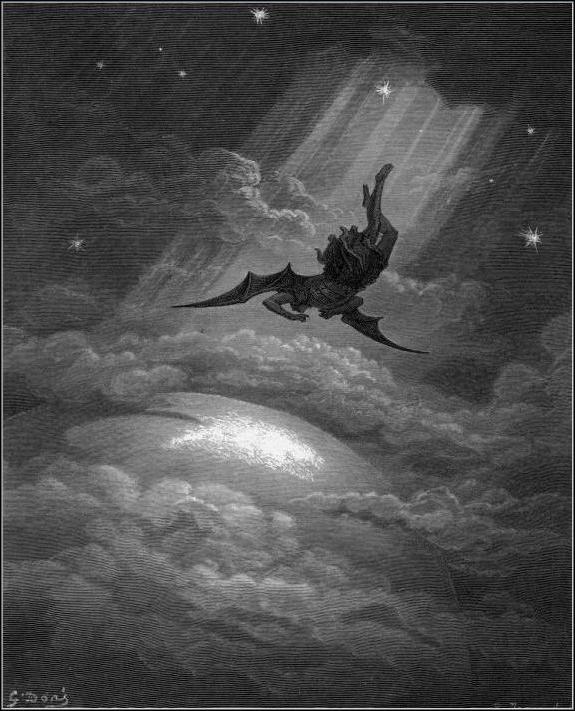
The first story in particular gives an example of the necessity for pride in the human spirit. If the boy had no pride, what prevents him from becoming the object and toy of any girl he becomes infatuated with? This is why the expression ‘Have you no pride?’ is usually employed as a reproach. It recognizes the importance of pride in asserting oneself and preventing other people from stepping all over us. In Christianity, all forms of pride are demonized. Pride is the first of the capital sins and the sin par excellence of Lucifer (admittedly here I’m steering towards later sources than the Gospels, but the traditions have become so engrained in Christian ideology that I feel it’s legitimate to cite them as well; anyway they’re not in contradiction with anything in the original text and they’re quite concordant with teachings in the Old Testament). By taking away the evil inherent in pride, you end up taking away the good as well (much like Dawkins does with religion itself). A man who takes no pride in his work does not do that work well. A man who takes no pride in his culture will not stand up to defend it.
Proud, yeah.

Above it all, a spark of pride asserts one’s agency in whatever the situation. Much like the boy declares by his act of refusal that he is not an object to be played with, and demonstrates this by his own decision to select a trying solitude over pleasing company, so the self-defeating act that we identify with pride is at the core of all free will. Lucifer assumed infinite pride, and first declared free will by demonstration. He assumed an infinite punishment for this. The repression of pride by Christianity then makes sense in the light of an hierarchical system of heaven (it is, after all, called the kingdom of heaven). Something like Christianity could not have sustained itself across the ages if it offered to its subordinates the possibility of independent action that is also ethical; that is to say, the possibility of a sentiment that originates from the self without being attached to or stemming from the kingdom of God, yet is still ethical and legitimate and dignified and right. This is exactly what a feeling of pride represents – the sense that we have a right to exercise our will and that no-one from the outside, however powerful, however mighty, can tell us ‘your feelings are wrong.’ For obvious reasons such a sentiment is not compatible with the concept of a God, and for this Christianity must reject it, painting it as the ultimate evil.

One of the reasons why this is not sustainable is that it fails to acknowledge that being a Christian means, primarily, assuming Christ as a choice, in other words, by an act of free will. There is an element of ‘rejecting the good’ in this choice too, since Christians choose poverty, asceticism, persecution and offering the other cheek over all the possible pleasures of the world, but this is kind of invalidated by the fact that greater good is later promised in heaven. At all events, in rejecting the human element of pride, Christianity unwarily blasts the seed that is at the core of its own promised salvation.

This is why the human spirit cannot be understood in dialectical terms (much less absolute ones), at least not from a moral point of view. Christianity not only contradicts itself by disowning the foundation of pride necessary for the free will which it invokes, it also denies the greatness of the human spirit by failing to account for its inherent ambiguity – its capacity, its necessity to contain and utilise both pride and humility, alternating elements of both in our walk of maturation.

A cursory look at the history of our literature better exemplifies this ambiguity. There’s poems which preach humility and call it the way towards wisdom (Eliot off the top of my head). There’s others which refuse to be humble, assert pride and also speak of its necessity (Baudelaire and Rimbaud, though somewhat erratically). So if two points of view are in contradiction, which one is right? The answer is – both of them, because they speak about different things (the possibility of several contradictory statements all being true simultaneously is important and I shall come back to it). Pride is what we need to face up to the outside world; if someone wishes to use you, your pride will keep you from being used, however seducing his / her offers may be. Humility is what we need to deal with our inner world; by understanding our own limits, we learn how much (or how little) we really deserve, and that measure becomes the wisdom by which we are humble to others and treat them with at least as much respect as we wish to be treated ourselves.

Christianity does not recognise this duality in the human spirit and does not forgive the pride I put in all the things I do. As such, it does not respect a true aspect of my self and my experience, and for this reason I cannot abide to its doctrine.

Monday, 7 December 2009

A Critique of Christianity: Prolegomenon


There’s an issue which comes up again and again when I chat with Christians who are trying to convert me. Perhaps surprisingly, it comes up with persistent frequency even when I speak with atheists who are trying to figure why I share their metaphysical scepticism. Both parties seem to think that I’m not a Christian because I don’t believe in God. The argument does hold some logical merit (I must admit), but it overlooks the question that to me is really pressing, and for this reason I shall expose it today.

You see, I don’t think it’s really important whether you believe or not in God. Some of you may disagree with this strongly, but it’s really not my first priority. What really matters to me is whether your dis/belief is something that leads you to connect and build bridges with other people, or whether you use it as a means to build walls between yourself and the experience of others. This distinction holds for atheists and believers alike, which is why it takes precedence over the more specialised questions of how and why you entertain a specific kind of faith.

This is also why I take my distances from the ideology of someone like Richard Dawkins (I might as well state this now) – not because I think there’s any immediate flaw in his reasoning, but because his reasoning is insufficient. It points out several things which are wrong with Christianity and religion in general, but it does so in such a way that it pulls a blind also over the things which are right. For this reason it is not constructive. Much as I admire the merits of The God Delusion (and I really do, for it combats religion in its discriminatory expressions, which are many and dangerous), atheism cannot take a form which refuses to engage with the principles of Christianity. It simply cannot. If that’s what it does, then it is only closure, and this leads to nowhere. Certainly not to spiritual illumination, which is something more profound than simply believing that yes, there is indeed that big guy up in the sky. Similarly Christians cannot refuse to engage with a text simply on account of the fact that it does not share – or even that it flat-out rejects – a Christian world-view. Much like atheists have a lot to learn from Christianity, so Christians should become aware of how much they have to learn from Nietzsche, Camus, or even Dawkins himself. The act of learning includes absorbing what’s right while filtering out what’s wrong, not blotting out anything that is not ideologically immaculate. In starting to open themselves to these people and reading them, holders of differing viewpoints can start learning from each other. Atheists can learn the humility that Jesus Christ teaches us and apply it in their everyday lives, even if they don’t believe there is a God to punish or reward them for it. Christians can learn from Nietzsche and Camus self-reliance, the joy of being alive and the value of the present, ephemeral moment, a view which loves life through the immediate and not just the transcendental. Atheists and Christians can learn from each other not in spite but because of their fundamental differences in worldview.

On this account my issue with Christianity does not relate to the in/existence of God. I do believe that I share a lot with Christian ideology: it teaches (personal and historical) humility, as I mentioned, and it is the earliest expression of pacifism that I know of. As importantly, it understands that pacifism starts in the spirit rather than being a mere social system – the pacifism and humility of those who see history as the mutilated body of an innocent on the cross, in Terry Eagleton’s words. Ours is a bloody heritage, and the Christian courage to acknowledge this is one of my favourite things about this religion – and, ultimately, one of the principles it asserts which is closest to my own spiritual principles.

So, given that I don’t think that dis/belief is really an issue that can separate two people in their way of life, on what grounds am I not a Christian? What is it, beyond the empirical statement ‘I do not see a God,’ that makes me feel like Christianity is not the path for me? How can we engage with Christianity in ways that go beyond the age-old query ‘is there a God?’ which has so long blinded us to other, equally important questions inherent in the adoption or rejection of a religion?

There are a number of principles which I don’t share with the Christian religion. I’m not saying that they are wrong in and of themselves, but they clash with my own personal sensibilities and my sense of justice, they are disharmonious with my experience and understanding of the world, and as such I feel it would be an act of insincerity if I were to ascribe to them. I wish to spend the next few posts to explore them.

One post every two days, four or five posts. And that will be my critique of Christianity done. See you here, see you soon.